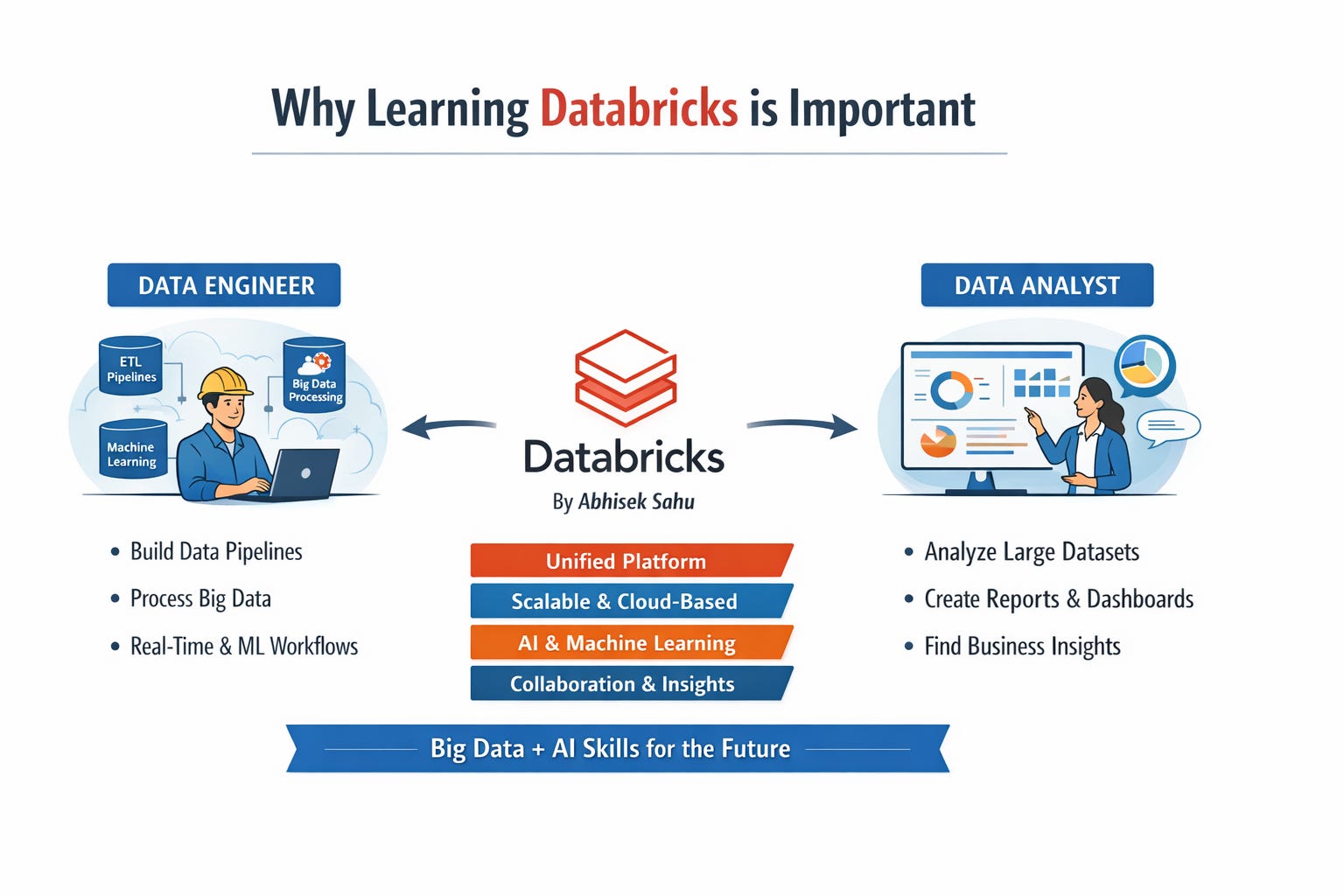
📈 Why Databricks matters for Data Engineers & Data Analysts - One platform, Two roles. Endless career growth
A single platform that bridges data engineering, analytics, and real world business impact.

🛢️ Why Databricks matters for Data Engineers
Think of data engineers as the builders of data pipelines. Their job is to take raw data (from databases, websites, apps, IoT devices) and turn it into clean, organized, ready-to-use data.
why it's important for DE:
Handles Big Data Easily: Can process millions or billions of rows quickly using Apache Spark.
Builds Reliable Pipelines: Engineers can create ETL (Extract, Transform, Load) pipelines that automatically clean and transform data.
Supports Streaming & Real-Time Data: You can process live data, like website clicks or sensor data, instantly.
Integrates with Machine Learning: Prepare datasets for ML models using MLflow and Delta Lake.
Cloud-Ready & Scalable: Works on Amazon Web Services (AWS), Microsoft Azure, or Google Cloud, so engineers don’t worry about server limits.
𝐒𝐢𝐦𝐩𝐥𝐞 𝐚𝐧𝐚𝐥𝐨𝐠𝐲:
Databricks is like a high-tech kitchen for data engineers. Raw ingredients (data) come in, and it helps you chop, mix, and cook the data so it’s ready to serve to analysts or ML models.
🛢️ Why Databricks matters for Data Analysts
Data analysts are like data detectives. Their job is to explore data, find trends, and create insights that help businesses make decisions.
Why it's important for DA:
Analyze Large Datasets: Even huge datasets can be queried quickly using SQL or Python.
Data Cleaning & Aggregation: Analysts can do light cleaning or summarizing data without waiting for engineers.
Build Dashboards & Reports: Integrates easily with BI tools like Power BI or Tableau for visualizing trends.
Collaborate with Engineers: Can access the same datasets engineers prepare, without constantly exporting/importing data.
Supports Experimentation: Quickly test hypotheses or calculate KPIs using Python, R, or SQL notebooks.
𝐒𝐢𝐦𝐩𝐥𝐞 𝐚𝐧𝐚𝐥𝐨𝐠𝐲:
Databricks is like a powerful microscope for analysts. They can zoom into huge amounts of data, explore patterns, and create clear insights for decision makers.
🛢️ Why learning Databricks benefits both roles
👉 Single Platform for Everyone: Engineers and analysts work on the same platform, which reduces miscommunication.
👉 Big Data Ready: Both roles can handle massive datasets efficiently.
👉 AI/ML Integration: Makes it easy for analysts and engineers to collaborate on machine learning projects.
👉 Future Proof Career: Companies are moving to cloud based big data platforms, and Databricks is widely adopted.
𝐁𝐨𝐭𝐭𝐨𝐦 𝐥𝐢𝐧𝐞:
Data Engineers: Build and maintain pipelines, process data at scale
Data Analysts: Explore, analyze, and visualize data efficiently
This is awesome 👌 👏, I'm glad you shared this insights. It's really making me feel better that I'm following the right track.
This is quite insightful. I am currently learning Databricks and it's been an amazing journey so far. I love how Databricks brings different skills (DA, DE, DS) into a central platform. Just to ask, is Databricks likened to Microsoft Fabric?